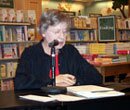
Colln, signing her novel, San Antonio Seduction,
at Landmark Booksellers, Franklin, Tennessee

Louise Colln

Novelist
Poet

An Excerpt

Tibbie's Journal

From Carolina Woman


We women who followed Bonnie Prince Charlie’s army to Culloden gathered in disordered groups or stayed alone, depending on our social circumstances. Some of the ones who traveled in carts or horseback found inns or houses to sleep in. Those on my level wrapped ourselves in capes or rags against the wet cold and waited on the ground for our men to return from battle.

On a miserable morning we heard sounds of battle. Shivering rain was slanted in by the wind. From our vantage point we could hardly make out what was happening on the battlefield, only that the red of the English uniforms seemed to be seen through the sodden air on all parts of the plain.

When we became aware that the battle was over so achingly soon, many of the women ran toward the hill, afraid of the English who were stomping through the battlefield, bloody swords smashing into unresisting bodies of wounded Scots. Some few of us drifted among the stacks of bodies looking for one particular man. Some for love. I searched to know if I was to be left alone in a darksome world.

The English soldiers were so drunken by the blood and the feel of swords slashing flesh that we women hardly entered into their minds. One or two of the women who stumbled into the path of a soldier were beheaded or cut in half by a careless slash of a thoughtlessly brandished arm. The rest I suppose drifted away.

I was searching the battlefield among the blood and dirt of the dead and wounded when a hand gripped my arm.

Come with me. I need help from someone quick enough to follow my instructions. Can you read?

I nodded. Madam my mother had taught me to read. Only a little. But he hadn’t asked how well I could read. If he thought someone who hadn’t washed or combed for weeks and who wore a torn and dirty dress under a sheepskin picked from the roadside looked quick enough to help him with whatsoever he needed he surely couldn’t care how well I could read.

I left my search and went with him. I was hardly emotional about a man who raped me and then used me as his slatern. I still don’t know if he survived. I can find it in my heart to wish that he did but that he didn’t come back to Edinburgh where I might meet him on the street but no more than that.

The man took me into a wretched cold building where he showed me how to apply pressure to stop bleeding and wrap a leg or arm with bandages torn from clothes taken off the dead. We struggled to treat some of the poor wretches that for reasons I couldn’t understand he wanted to keep alive. Better I thought to follow the lead of the English who were killing anyone still breathing out on the battlefield. And very few did we manage to snatch away from them or to keep away from death by bleeding or the ugly stinking infection. Perhaps some of the few other medicine men did better.

That was my introduction to the art of medicine and my introduction to Mister G of Edinburgh. It was later that I learned his real reason for working with the wounded. There may have been some who worked that day for compassion for the pitiful bodies of tortured humanity. G worked then and always afterward for the knowledge he could get from the broken bodies. Perhaps in the end of reasons it was the same for G gave every bit of knowledge he obtained to the medical world.

It didn’t take G long to realize that I had lied to him about being able to read. I think he never realized that I didn’t know I was lying. I thought that knowing the sound of letters and spending time with my mother trying to sound them into words was reading. Perhaps I was right and G was wrong.

G took me back to Edinburgh with him after our pitiful attempts to save a few Highlanders and turn them over to clansmen. I had no emotional ties to the man who had saved me for his own uses and had no sense of right and wrong about changing bed partners since this was the only way for a maybe fourteen-year-old woman to stay alive and fed.

G found me a tiny room up a narrow stairway high in a crowded building that always seemed to me to be leaning against the tall rock where the military fortress soared. I learned later that he and his family lived below me though he spent much time at the medical college sometimes not coming home for weeks. Sometimes coming to me before going home. He gave me paper. He gave me ink. Every day I practiced putting letters on paper and making them into words. Something my mother in a tinker’s caravan couldn’t do. She could only say the letters to me and have me repeat them.

Often he spent time teaching me information from the college and left without bedding me. Slowly I realized that his desire was to send me out to visit and treat the poor victims of Edinburgh when possible and to bring him back every detail I could observe.

I sometimes wonder if G in his own way has the sight or that Madam my dead mother was passionately caring for me in influencing him that he saw in me the ability to learn from him and my eagerness to take his knowledge to the poor creatures who only lived to work and die.

***

Now that I can write my reports to G I must be careful in my use of paper and ink for he only gives me the amount that he thinks I will use for him and I must keep my thoughts to a few lines, but I can write day by day now, though only many days apart.

G has moved his family out of my building to a house in a nearby close. I am glad for I no longer have to use the same narrow staircase as them.

Now that G has been tutoring me for several years including the ones I lost the telling of by not being able to write in my journal I know that he has love only for knowledge. It has been many months, perhaps years, since he has bedded me. I only thank the god of the soaring churches on the rich streets that he no longer looks for that in me. Knowledge is growing at the college of medicine and I feel thankfulness for the line of my life that brings even a little of that knowledge to me through him. And lets me take the good of that knowledge to the poorest and neediest. I stand in the middle giving G what I observe in my neighbors and giving my patients the results of his wisdom.

He has an apprentice in the college. Many times over these years he had had me take my observations to this man who seems to know of my living arrangements. I can tell by the way he looks at me. But I will not become that person again to any man.

G cares little for the women who bear children. I care greatly. At first I reported to him the problems of misplaced babies in the womb, women who fail to stop bleeding after birth, those who die of fever. He believes this is only a part of being a woman, I am grateful that I have never carried a child in my body but I wonder. Would he be as uncaring if I should die screaming that the child inside me could not be pushed out? I want to learn the knowledge of the midwife as well as the wisdom from the college.

I have found a midwife on the streets who teaches me the methods and medicines of birthing. She explains to me how to tell in advance if the child is misplaced if the mother will allow me to visit from when she is first carrying her child. Most of them will only call on me when her time has come. But she has taught me how to find a misplaced leg or arm and bring out a babe who is turned wrong even while the birth is coming on.

Some medical men at the college are becoming interested in the act of giving birth. I have seen some of what they do. We who practice outside the college are felt to be below their level but I make a clean and quiet space for my mothers, as much as possible, and I do believe more of my mothers live.

I am writing down the methods and the medicines that help in another part of these papers. I don’t talk to G about my babies anymore. I think he would only care about the time I spend with them.

I have gone into the churches and listened to the sermons which are long but speak of a god I’m becoming close to. I think perhaps he approves of my work with the poorest in the high buildings no matter how I came to it. But I don’t think of telling my history to anyone. Only to these scraps of paper and the few words I write now and then. Perhaps someday I will ask that god for forgiveness the way the preachers call for but I don’t know how to separate my history at present.

G has sent me into a building in a close near the great church where the people are puking their lives out while their skin erupts and bodies wait for the dead wagon to be taken to the street. The plague. The killing plague that returns again and again. I am tired. Not even the men at the college know what to do for these people. G asks me to report. I can only tell him what I have written here. I am tired.

G has died. I only heard it from the midwife who guesses what our relationship was.

I only guess at my relationship with G. It wasn’t love but a need we filled for each other. But I mourn him. How many years we have been a part of each other’s life. How much he has taught me though it has always been for selfish reasons on his part. I accept that. He changed my life for the better. He needed and gave me more than a bedmate and he kept our relationship going long after he no longer wanted me as a bedmate. He gave me the respect in myself of knowledge that helps people even though I am still often thought of as a witch, long after it is claimed that witches are no longer burned in Scotland. Wanting my reports to be understandable he taught me words and a way of writing I would never have known as a daughter of a tinker.

Now I am my own sponsor. I have planned for this day knowing that G was growing old. I can buy food and a place to sleep. That is all I need. Over the last few years I have set a small fee for my midwife services, without telling G. Only for those who can afford to pay. I have taken over my teacher’s patients as she grows older.

Now that G is gone, his apprentice (long out on his own) pushes to take over G’s place in my life. I will not. I am my own person. I am my own soul neither beholden to any man nor willing ever again to give favors for survival. Old as I am I can choose my future.

I am going to talk to someone about taking my knowledge to the Colonies. I want to leave everything I have been here behind. I am afraid when some ignorant husband points me out as a witch, even as I come to his wife’s bedside, bringing my herbs and my knowledge to keep her alive for him.

Now is another great change. Now I have learned that changes come out of the heavens if you look to the heavens. But we each choose our changes even if our only choice is how we respond to the experiences covering us like ocean waves. There is a circle.

I am on my way. I have found an isolated tavern in the colonial state of South Carolina so far away from the cities that there are still Indian wars going on. So in need of medicine, those women in the area only treat each other out of ignorance. I truly believe that this is what I have lived my life for.

After the sea voyage. In the wagon on our way through the dark South Carolina interior. On our way to new things. And who knows what it will be? But better. A few more days of moving along, a few more nights of heat and mosquitoes, some more marshes, some more furrowed roads. This I know. I am traveling toward good. I cannot wait.

It is true. This is what I was born for. The need is great here. The need was great in the tall buildings of Edinburgh but her there is only one worker. Myself. And the young friend I met on the boat who is not aware yet that she is a healer. I will teach her.


Louise Colln, signing her novel San Antonio Seduction


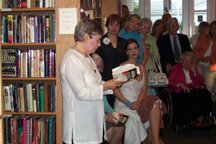
Louise Colln, reading from her novel San Antonio Seduction
Louise Colln is the author of five nationally and internationally published books. Four of them have been reprinted, three in anthologies. She first published her writing while working in nursing service administration and, with her husband, raising five children. She writes both historical and contemporary books. She presently has a manuscript set in the Depression Era of the Nineteen Thirties. Her poetry and short stories have won statewide contests and have been published in national magazines. Her work is in all three Williamson County Literary Reviews, Voices from The Missouri Heartlands, Ozarks, Muscadine Lines: A Southern Anthology, Gathering: Writers of Williamson County, and Gotcha Covered: A Legacy Of Service And Protection. She is co-author of Echoes Of Two Voices, a Civil War poetry book, and is available with her co-author, Nancy Fletcher-Blume, for readings. She condensed and adapted A Little Princess, Black Beauty and Rebecca of Sunnybrook Farm for Dalmatian Press. She served as editor for a genealogy magazine in Missouri and for the Middle Tennessee Scottish Society Newsletter. Louise leads workshops. Her work with school children includes helping them create stories, leading a critique group, and serving as a judge in the Williamson County Family Resource Center school contests. She served as master of ceremonies at Tennessee Writer’s Alliance Read Arounds. She was secretary to the Council For The Written Word, Middle Tennessee Scottish Society, and the governing board of the Tennessee Writers’ Alliance. In 2009 her work appeared in an e-zine, two anthologies, and an inspirational booklet.